
“How do you know?”
“I don’t know. I’m just afraid . . .”
Remember that scene in Home Alone where Kevin decides to be the man of the house?
Rousing himself from his hiding place under the bed, he marches boldly out the front door and exclaims into the night,
“I’m not afraid anymore! You hear me? I said, I’m not afraid anymore!”
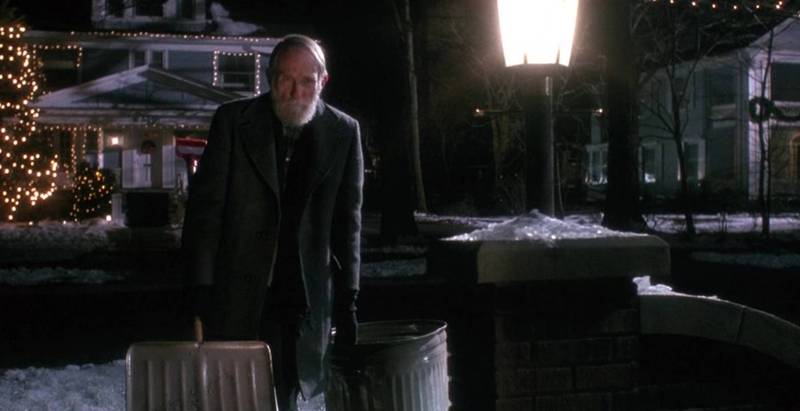
But, just then, his mysterious neighbor, Old Man Marley, walks by with a snow shovel and a bin of salt. All of a sudden Kevin’s new-found resolve vanishes as he runs back inside screaming.
In this exchange we see the whole core of the film. Once Kevin has come to terms with the idea of robbers, that is, once he understands the threat, he can face it. But what he cannot face, is a myth. The unknown is far more terrifying than the worst of known enemies.
I say this is the “core” of the film, you may call it the “theme” or whatever you like, but the point is that it gives the film its structure and coherence. If we examine any of the major character conflicts, they will all bring us back here: the fear of the unknown.
Consider Mrs. McCallister. Her most immediate inner conflict is having no way of knowing if Kevin is okay. Even her outer, physical conflict—not being able to get back home—is ultimately about her desire to see and know for herself that he is okay. All the remorse and apologies and explanations follow after the knowing.
“Has the child been involved in a violent altercation with a drunken and/or mentally ill member of his immediate family?”
“No.”
“Has he been involved in a household accident?”
“I don’t know . . . I . . . I hope not.”
“Has your child ingested any poison and/or has any object become lodged in his throat?”
“No, he’s just home alone! And I would like somebody to go over to the house and see that he’s alright.”
(Of course, this conflict also happens to be a microcosm of the perennial parental fear of a child growing up and being on their own, out of the direct help and omniscience of the parent.)
Then consider a seemingly minor character like Old Man Marley. His conflict is not ultimately that his son won’t talk to him, but rather that he doesn’t know whether his son will talk to him or not. His poignant exchange with Kevin begins by encouraging Kevin to not be afraid to speak to him and to disbelieve the lies about him, and ends with Kevin returning the very same encouragement regarding Marley’s son.
“Why don’t you call him?”
“I’m afraid if I call him he won’t talk to me.”
“How do you know?”
“I don’t know. I’m just afraid he won’t.”
Even consider the Wet Bandits. Their downfall is caused by a fear of being unknown. Marv is compelled to make himself known by having a signature of some sort.
“What’s wrong with you? Why do you do that? I told you not to do it.”
“Harry, it’s our calling card. All the great ones leave their mark. We’re the Wet Bandits!”
Each of these conflicts is ultimately resolved by embracing the unknown in some way. Kevin embraces the unknown of living alone by learning to do chores and take care of himself
“I don’t know how to pack my suitcase!”
…
“I went shopping!”
His mom takes a cross-country ride in the back of a moving van with complete strangers (she makes it very clear she has no clue who “the polka king of the Midwest” is); Marley calls his son; and the Wet Bandits realize that embracing anonymity might not have been such a bad idea after all . . .
“Nice move—always leaving the water running. Now we know each and every house that you’ve hit.”
~ ~ ~
Now, I’m not here to expound the merits of Home Alone in particular. My reason for laying all this out is simply because I got excited after I started to see how well the pieces fit together after having seen the film a dozen? two dozen? times.
Even familiar stories can become exciting again if we take a minute to pull the end of a thread we find and see where it leads us. And maybe finding the small threads in stories that we know all-too-well can help us to find the big threads in new stories we’ve never encountered before.
 The Filmlings